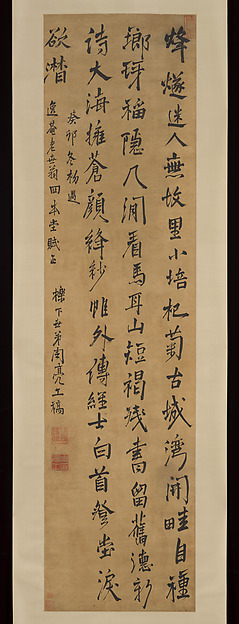
The Poem Before Paraphrase
This block uses Wanderer's Song, Meng Jiao, 遊子吟 as the anchor, with "慈母手中線,遊子身上衣。臨行密密縫,意恐遲遲歸。誰言寸草心,..." kept in front of the explanation.
Full Text: The page uses all six lines because the emotional turn depends on sequence. The poem begins with hands, thread, and clothing. It then shows the dense sewing before departure. Only after that does the grass and spring comparison appear. The famous final image needs the sewing scene to earn it.
Mother's Thread: Ci mu shou zhong xian places care in the mother's hand before naming emotion directly. The line is concrete: thread, hand, and clothing. That concreteness keeps the poem from becoming a general statement about love too early.
Traveler's Clothing: You zi is the traveling son, not just any child. The garment on his body carries the mother's work into his journey. The poem links distance and care through clothing, so the son remains wrapped in an action performed before departure.
Images, Sound, And Emotional Turn
Dense Sewing: Mi mi feng is the poem's central action. The repeated sound suggests tight, careful work. The mother sews densely because she fears delayed return. The care is practical, but it is also emotional, because the garment is prepared for absence.
Late Return: Chi chi gui slows the line down. The mother's fear is not only that the son leaves, but that he may come back late. The delay is imagined before it happens. That imagined delay is why a simple sewing scene carries future sorrow.
Grass And Spring: Cun cao xin and san chun hui create the final comparison. A small blade of grass has life because spring shines on it, but it cannot repay spring's radiance. The poem uses that imbalance to describe the child's relation to maternal care.
Keep the term set visible here: ci mu, you zi, mi mi feng. The reading changes if one of these terms is translated too smoothly.
Translation Choices To Keep Visible
Why Repayment Fails: The poem does not say the child should stop trying to be grateful. It says the scale of repayment cannot match the scale of received care. That is why the grass image is so exact. Grass grows because spring gives light and warmth everywhere; the small life cannot return that original abundance.
Meng Jiao's wanderer's song Translation Limit: This working translation keeps inch of grass and three spring radiance because those images are stranger and more exact than a plain paraphrase such as no child can repay a mother. The poem's power lies in the concrete metaphor, not only in the moral lesson.
Meng Jiao's wanderer's song Reading Payoff: This page differs from Yuan Zhen's grief poem because Meng Jiao builds feeling through domestic action rather than comparison to sea and clouds. It differs from Du Fu's Moonlit Night because the family bond here is shown before departure, not across wartime distance. The article gives readers a source-based way to quote the poem without losing its sewing logic.
The reading should end in one practical move: Compare this page with Du Fu's Moonlit Night before treating all family poems as the same kind of longing.