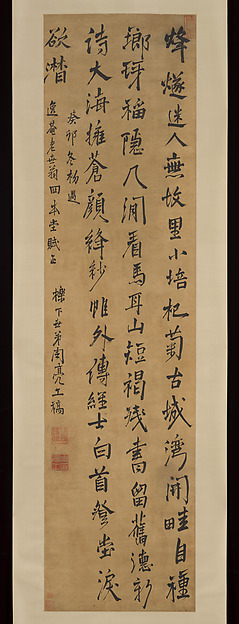
The Poem Before Paraphrase
This block uses Moonlit Night, Du Fu, Tang poem as the anchor, with "今夜鄜州月,閨中只獨看。遙憐小兒女,未解憶長安。香霧雲鬟濕,..." kept in front of the explanation.
Full Poem: The page uses the full eight-line poem because its emotional force depends on displacement. The speaker's mind travels to Fuzhou, imagines his wife's solitary moon-viewing, thinks of children who do not yet understand, and only at the end imagines reunion. The poem is carefully staged, not merely a moonlit sigh.
Moon Over Fuzhou: Jin ye Fuzhou yue places the moon in Fuzhou, not where the speaker currently stands. That opening is decisive. The poem begins by relocating perception to the family side. The moon becomes shared by distance, but the first imagined viewer is the wife, watching from the inner room.
Watching Alone: Gui zhong zhi du kan says she watches alone in the inner chamber. The loneliness belongs first to the imagined wife. Du Fu's speaker does not center only his own feeling. He gives the poem's first loneliness to another person, which makes the poem intimate and ethically attentive.
Images, Sound, And Emotional Turn
Children Who Do Not Understand: The children are pitied from afar because they do not yet understand remembering Chang'an. This detail deepens the family scene. The poem is not only about a couple separated by war or duty; it includes children whose innocence keeps them from understanding the full shape of loss.
Mist And Hair: Xiang wu yun huan shi imagines fragrant mist wetting cloudlike hair. The image is delicate, but it is not decorative alone. It brings the wife's body into the night air. Distance has become concrete: the speaker imagines the physical effects of the moonlit, misty scene on her.
Cold Moonlight: Qing hui yu bi han says clear radiance chills jade arms. Moonlight is beautiful, but it is also cold. The body registers separation. A weak reading would make the poem only graceful. A closer reading sees that beauty intensifies vulnerability because the wife is imagined alone under that light.
Keep the term set visible here: Fuzhou yue, gui zhong, xiao er nu. The reading changes if one of these terms is translated too smoothly.
Translation Choices To Keep Visible
Double Illumination: Shuang zhao looks toward a future when both will be shone upon together. The poem does not end by escaping moonlight. It asks for moonlight to become shared again. The same light that now marks distance might one day illuminate reunion and dry the tear marks.
Du Fu's Moonlit Night Translation Limit: A careful translation should preserve the viewpoint shift. If the poem is translated as a simple I miss my family poem, it loses its unusual structure. The speaker imagines the beloved's seeing, the children's not understanding, and the body's coldness before speaking of his own hope for reunion.
Du Fu's Moonlit Night Reading Payoff: This page differs from Spring View because it narrows wartime separation into one imagined family night. It differs from Li Bai's Drinking Alone Under the Moon because Du Fu's moon connects separated people rather than creating playful companions. The article gives readers a source-based way to read moon imagery as displaced care.
The reading should end in one practical move: Compare this page with Du Fu's Spring View and Li Bai's Drinking Alone Under the Moon before treating Tang moon poems as interchangeable.