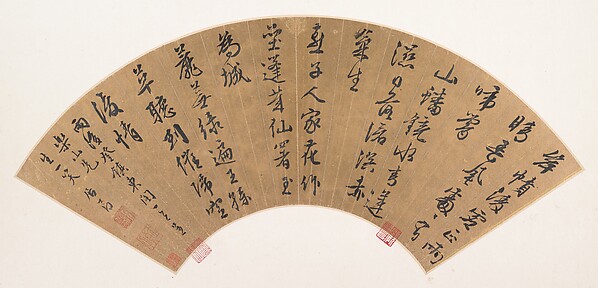
The Poem Before Paraphrase
This block uses Sending Meng Haoran To Guangling From Yellow Crane Tower, Li Bai, 黃鶴樓送孟浩然之廣陵 as the anchor, with "故人西辭黃鶴樓,煙花三月下揚州。孤帆遠影碧空盡,惟見長江天際..." kept in front of the explanation.
Full Text: The page uses all four lines because the poem depends on visual sequence. The friend leaves from a named tower, the season and destination are given, the sail recedes, and the river remains. The emotion is built by watching rather than explaining.
Old Friend: Gu ren is old friend, not merely traveler. The relationship matters because the poem's restraint depends on not naming grief directly. The friend is close enough that the vanishing sail can carry feeling.
Yellow Crane Tower: Huanghe Lou gives the farewell a famous high vantage point. The poem does not describe the building at length. It uses the tower as a departure point from which the speaker can watch distance open across the river.
Misty Blossom March: Yan hua san yue gives season and atmosphere. The journey to Yangzhou happens in a beautiful time, not in bleak weather. That beauty makes the farewell more delicate: the world is attractive, yet the friend is leaving.
Images, Sound, And Emotional Turn
Lone Sail: Gu fan yuan ying is the poem's visual center. The sail is lone, distant, and finally disappearing. The friend is not described after departure; the sail becomes the visible trace of him until even that trace ends.
Only The Yangtze: Wei jian Changjiang tian ji liu gives the final residue of sight. Once the sail has vanished, the river keeps flowing to the horizon. The poem leaves the reader with motion that continues after human contact has disappeared.
Watching As Farewell: The speaker's main action is watching. He does not report a conversation, a gift, or a final speech. That restraint makes the poem visual and durable. Farewell becomes the act of keeping the departing friend in sight until the world itself, the blue sky and the Yangtze, absorbs the last trace.
Li Bai's farewell at Yellow Crane Tower Translation Limit: This working translation keeps blue emptiness and edge of heaven rather than turning the last lines into a flat he sailed away. The spatial language is essential because the poem's sadness is carried by the widening view.
Keep the term set visible here: gu ren, Huanghe Lou, yan hua. The reading changes if one of these terms is translated too smoothly.
Translation Choices To Keep Visible
Li Bai's farewell at Yellow Crane Tower Reading Payoff: This page differs from Bai Juyi's grass farewell because Li Bai uses river distance and a vanishing sail, while Bai Juyi uses grass, old road, and ruined city. It differs from Gao Shi's Farewell to Dong Da because Li Bai does not offer public encouragement; he watches until only water remains. The article gives readers a source-based way to read the famous farewell without turning it into generic goodbye sentiment.
Li Bai's farewell at Yellow Crane Tower Source Checkpoint: Let the poem move line by line before paraphrase begins: Sending Meng Haoran To Guangling From Yellow Crane Tower, Li Bai, 黃鶴樓送孟浩然之廣陵, opening with "故人西辭黃鶴樓,煙花三月下揚州。孤帆遠影碧空盡,惟見長江...". Keep gu ren beside the Chinese wording before accepting the readable English. On this page the source anchor is doing real work: it tells the reader where the claim begins, which phrase is being interpreted, and why the explanation should stay narrower than a later proverb or author label.
Li Bai's farewell at Yellow Crane Tower Reader Decision: The practical decision is whether the reader can watch image order, sound, and the emotional turn. Compare gu ren with Huanghe Lou, then ask which English phrase compresses the most. That check blocks the common mistake of summarizing the feeling before seeing how the lines create it; it also gives the page a finish line, so the reader leaves with a source habit rather than a smoother slogan.
The reading should end in one practical move: Compare this page with Bai Juyi's grass farewell before treating every Tang farewell as the same kind of parting.