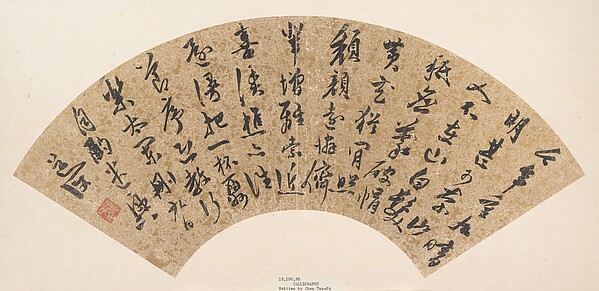
The Poem Before Paraphrase
This block uses Viewing The Waterfall At Mount Lu, Li Bai, 望廬山瀑布 as the anchor, with "日照香爐生紫煙,遙看瀑布掛前川。飛流直下三千尺,疑是銀河落九..." kept in front of the explanation.
Full Text: The page uses the four-line jueju because each line increases the view. Sunlight creates mist, the distant eye frames the waterfall, the water drops vertically, and the last line changes landscape into astronomy. Removing any line weakens that climb in scale.
Incense Burner Peak: Xianglu is usually understood as Incense Burner Peak at Mount Lu. The name matters because the first line's purple mist fits both mountain atmosphere and the incense image. The poem begins with a place name that already invites a visual transformation.
Distant Viewing: Yao kan means looking from afar. The waterfall is not described from inside the spray; it is seen at enough distance to appear as a hanging strip before the river. That distance lets the imagination enlarge the object rather than measure it closely.
Images, Sound, And Emotional Turn
Three Thousand Feet: San qian chi should not be read as a surveyor's number. The line uses height as poetic magnitude. The waterfall's downward force is made imaginable through excess, which prepares the Milky Way comparison in the final line.
Milky Way Falling: Yinhe luo jiu tian is the leap that makes the poem famous. The waterfall becomes the Milky Way falling from the ninth heaven. This is not scientific description; it is Li Bai's way of making vertical water feel celestial.
Why Distance Matters: The poem's exaggeration depends on the speaker not standing too close. From a distance, the waterfall can become a hanging band, a plunging line, and finally a celestial object. The page therefore reads yao kan as structural, not incidental. Distance gives the imagination room to turn landscape into Milky Way scale.
Keep the term set visible here: Xianglu, zi yan, pu bu. The reading changes if one of these terms is translated too smoothly.
Translation Choices To Keep Visible
Li Bai's waterfall at Mount Lu Translation Limit: This working translation keeps three thousand feet and ninth heaven because those phrases carry the poem's scale. Smoothing them into very high or from the sky would be readable, but it would remove the extravagant register that makes the poem recognizably Li Bai.
From Place To Vision: The poem starts with a named mountain location, but it does not remain a topographical note. Incense Burner Peak, purple mist, and the hanging waterfall become steps toward a visionary comparison. That movement is why the poem still works for readers who have never visited Mount Lu: the place is specific, while the imaginative scale is open.
Li Bai's waterfall at Mount Lu Reading Payoff: This page differs from Du Fu's Climbing High because Li Bai turns a single waterfall into cosmic vision, while Du Fu turns a high viewpoint into age, illness, exile, and grief. It differs from Wang Wei's mountain dwelling because Wang Wei quiets the mountain scene, while Li Bai intensifies it. The article gives readers a source-based way to quote the waterfall without mistaking hyperbole for literal measurement.
The reading should end in one practical move: Compare this page with Du Fu's Climbing High before treating every mountain viewpoint as the same kind of grandeur.