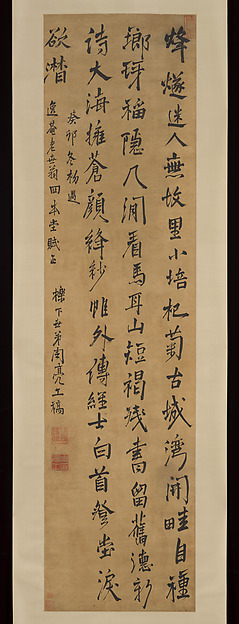
The Poem Before Paraphrase
This block uses Autumn Comes, Li He, 秋來 as the anchor, with "桐風驚心壯士苦,衰燈絡緯啼寒素。誰看青簡一編書,不遣花蟲粉空..." kept in front of the explanation.
Full Text: The page uses all eight lines because Li He's poem builds by accumulation. Wind, lamp, insects, writing, rain, spirit, graves, ghosts, and blood all matter. Extracting only one image would make the poem easier but would hide the density that makes Li He difficult.
Paulownia Wind: Tong feng is not just autumn breeze. Paulownia can carry seasonal and literary associations, and the wind startles the heart. The opening immediately links weather to shock and suffering. The zhuang shi, the strong or brave man, is not untouched by the season.
Failing Lamp And Insect Cry: Shuai deng and luo wei create a small, cold interior. The failing lamp and cricket-like sound make the poem feel late, thin, and exposed. Han su, cold plain cloth, keeps the scene austere. This is far from a warm autumn landscape.
Images, Sound, And Emotional Turn
Threatened Writing: The question about qing jian, a written roll or slips, shifts the poem toward textual survival. Hua chong powdering or worming the text suggests decay. The poem worries not only about a person but about whether writing can avoid useless destruction.
Body Pulled By Thought: Si qian jin ye chang ying zhi is physically strange. Thought pulls so hard that the intestines should become straight. The poem lets emotion act on the body in an extreme way. That difficulty should not be over-polished in translation.
Cold Rain And Book Guest: Yu leng xiang hun diao shu ke brings cold rain and a fragrant spirit mourning the book guest. The phrase keeps literature, spirit, and grief together. The page reads shu ke as a figure tied to books and writing, not simply a generic traveler.
Keep the term set visible here: tong feng, luo wei, qing jian. The reading changes if one of these terms is translated too smoothly.
Translation Choices To Keep Visible
Ghosts And Bao Family Poems: The autumn graves and ghosts singing Bao family poems push the poem into the uncanny. Li He often works with startling, death-leaning images. The allusion should not be flattened into spooky atmosphere; it connects poetic memory with graveyard persistence.
Li He on autumn wind Translation Limit: This working translation stays close to the images even when the English feels unusual. That is intentional. A very smooth paraphrase would make Li He sound like ordinary autumn sadness. The page instead shows where the images are difficult, bodily, textual, and ghostly.
Li He on autumn wind Reading Payoff: This page differs from Du Mu's Qingming because Li He's autumn is inward, textual, and uncanny rather than a public seasonal road. It differs from Zhang Ji's night mooring because sound here comes from insects and ghosts rather than a temple bell. The article gives readers a source-based way to approach Li He's difficulty without pretending every image is simple.
The reading should end in one practical move: Compare this page with Zhang Ji's night mooring and Du Mu's Qingming before treating Tang seasonal poems as one gentle mood.