The Poem Before Paraphrase
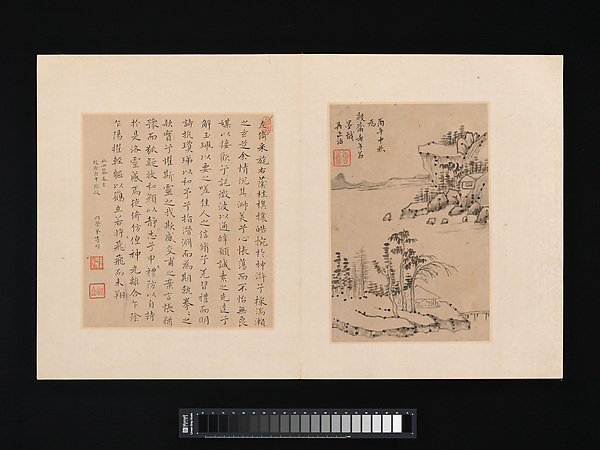
This block uses Seeking a Hermit and Not Meeting, Jia Dao, 尋隱者不遇 as the anchor, with "松下問童子,言師採藥去。只在此山中,雲深不知處。" kept in front of the explanation.
Full Text: The page uses all four lines because the poem works as a compressed dialogue. The questions are mostly omitted, and the answers carry them inside. That structure makes the poem feel spare while still containing a small search, report, hope, and uncertainty.
Under The Pine: Song xia gives the first image. The seeker stands under a pine, a tree often associated with mountain reclusion and endurance. Before the hermit appears, the scene already points toward a world outside ordinary city life.
The Young Attendant: Tong zi is the one who speaks. The hermit himself is absent, so the poem gives us a mediator. This matters because the speaker's knowledge comes secondhand. The poem's restraint depends on hearing about the hermit rather than seeing him.
Images, Sound, And Emotional Turn
Gathering Herbs: Cai yao qu explains the absence. The master has gone to gather herbs. The detail fits a reclusive, mountain, or medicinal life without overexplaining it. The hermit is active in the mountain, not simply unavailable.
Only In This Mountain: Zhi zai ci shan zhong gives hope. The hermit is only in this mountain. The word only makes the absence feel almost solvable, as if distance is not the problem. But the next line removes that certainty.
Deep Clouds: Yun shen bu zhi chu is the poem's closing veil. The clouds are deep, and the place is unknown. The mountain becomes both near and unreachable. The poem does not need to say disappointment; the cloud image carries it.
Keep the term set visible here: song xia, tong zi, cai yao. The reading changes if one of these terms is translated too smoothly.
Translation Choices To Keep Visible
Jia Dao's seeking a hermit Translation Limit: This working translation keeps the child as attendant and the master as teacher to preserve the relationship implied by tong zi and shi. It also keeps only within this mountain because that small assurance is what makes the final uncertainty sharper.
Nearness Without Arrival: The poem is not about a failed appointment in an ordinary sense. The hermit is not absent from the mountain, only absent from the visitor's reach. That difference matters. The answer gives location, activity, and hope, but the final cloud line refuses possession. The page reads the poem as a study of nearness without arrival rather than a simple disappointment.
Jia Dao's seeking a hermit Reading Payoff: This page differs from Liu Zongyuan's River Snow because Jia Dao keeps a human search and answer structure, while River Snow removes almost all traces. It differs from Han Yu's Mountain Stones because Han Yu travels through a route and temple, while Jia Dao stops at the edge of hidden presence. The article gives readers a source-based way to read the poem's absence without making it vague mysticism.
The reading should end in one practical move: Compare this page with River Snow and Han Yu's Mountain Stones before treating all mountain poems as the same kind of solitude.