Practical guide
Dao De Jing Chapter 64: Small Beginnings and Care at the End
Read small beginnings alongside the warnings about grasping, care near completion and the sage’s closing assistance. Keep the received text, our translation, Wang Bi’s notes and your own application separate.
Read the complete received chapter before the famous line
Chapter 64 of the Dao De Jing, also called the Tao Te Ching, includes the famous thousand-li journey line. Its wider movement asks readers to attend to small conditions, reconsider forceful intervention and keep care near completion. The final clauses concern desire, learning and assisting what is self-so.
The Chinese below follows the received text displayed with Wang Bi’s commentary in the linked edition. We separate the chapter from the notes. Our English is a working translation made for this guide; “contrived action” and “self-so” are explained interpretive choices.
其安易持,其未兆易謀。其脆易泮,其微易散。為之於未有,治之於未亂。合抱之木,生於毫末;九層之臺,起於累土;千里之行,始於足下。為者敗之,執者失之。是以聖人無為故無敗,無執故無失。民之從事,常於幾成而敗之。慎終如始,則無敗事。是以聖人欲不欲,不貴難得之貨;學不學,復眾人之所過。以輔萬物之自然,而不敢為。Read the English in the same order:
1. What is settled is easy to maintain; what has not yet given a sign is easy to plan for. What is fragile is easy to break apart; what is minute is easy to disperse.
2. Attend to it before it has arisen; put it in order before it is disordered.
3. A tree that fills the embracing arms grows from a fine tip; a nine-tiered platform rises from accumulated earth; a journey of a thousand li begins beneath the feet.
4. Those who act upon it spoil it; those who grasp it lose it.
5. Therefore the sage is without contrived action and so does not spoil; without grasping and so does not lose.
6. When people pursue an undertaking, they often spoil it when it is nearly complete. Be as careful at the end as at the beginning, and there will be no spoiled undertaking.
7. Therefore the sage desires not-desiring and does not prize goods difficult to obtain;
8. learns not-learning and returns to what people have passed beyond.
9. In this way the sage assists the self-so character of the myriad things and does not dare to act upon them.
The numbered units are our reading divisions. They make the sequence easier to follow; they are not a claim about the layout of an ancient manuscript.
The tree, platform and journey give the beginning its scale
The opening moves through four conditions: settled, not yet showing signs, fragile and minute. They present an opportunity to attend before something becomes harder to address. The next paired instruction explicitly mentions what has not arisen and what has not become disordered.
Then come three images: an embracing tree, a nine-tiered platform and a thousand-li journey. The tree’s 毫末 is rendered here as a fine tip. “Tiny sprout” is a readable explanatory rendering, but the compressed Chinese is not a botanical account of germination. The platform’s 累土 brings accumulation into the picture.
The journey line, 千里之行,始於足下, keeps the long distance connected with where one stands. Tone-free pinyin for identifying the line is qian li zhi xing, shi yu zu xia. Our “beneath the feet” stays closer to zu xia than the familiar “single step.” Neither choice should silently become a quotation from a translator who has not been named.
Keep li visible when discussing the wording. “A thousand miles” is a familiar English way to convey a long journey, but it substitutes an English distance word. This passage does not give a modern conversion or a measured itinerary.
As a reading exercise, put three headings beside the images: emergence, accumulation and beginning where you are. They bring out different features of the comparison. Reducing all three to “just start” makes the image memorable while losing some of the sequence.
Read attention alongside the warning against acting upon and grasping
Immediately after the journey image, the chapter says 為者敗之,執者失之: those who act upon it spoil it; those who grasp it lose it. This creates a problem for a reading that treats the earlier words as a command to force every outcome.
Our use of “contrived action” in the sage sentence brings that tension into English. It is an interpretation of wu wei, not a replacement Chinese character. Other translations may use nonaction or non-doing. A useful explanation shows how its choice handles both the instruction to attend and the warning about doing.
Wang Bi’s note on the warning contrasts careful attention with an intervention that gives rise to the problem it tries to control. You can use that named reading to ask what kind of action the chapter questions. You still need to distinguish it from the chapter’s shorter wording.
A fictional example might be an editor changing every sentence of another writer’s nearly finished draft without understanding it. It illustrates a question about interference. It does not establish that editing is always harmful, or that withholding all help follows from the text. The final fu (輔), assisting, will matter to that distinction.
慎終如始 keeps care near completion, not only at the start
The chapter directly names an often-missed risk: 民之從事,常於幾成而敗之. In our English, people often spoil an undertaking when it is nearly complete. Ji cheng (幾成) marks proximity to completion, not simply a vague reference to difficulty.
慎終如始, shen zhong ru shi, then asks for care at the end as at the beginning. The earlier emphasis on what is small should be read with this later emphasis. A beginning can be careful while a finish becomes careless.
Wang Bi makes the connection especially explicit. After the four opening conditions, his note says 此四者,皆說慎終也. Our translation of the note is “These four all speak of care at the end.” He also treats neglecting what is absent or minute as a way it can develop into something larger.
This reading prevents a simple start-to-finish chart from being mistaken for the entire argument. The opening can concern vigilance that continues, rather than a stage you pass once and forget. The original map below shows textual order; it does not turn the chapter into a guaranteed project procedure.
The phrase 則無敗事 belongs to this philosophical argument. A modern reflection can ask where attention has dropped off near completion. Turning it into a promise that any chosen checklist will eliminate every real-world failure adds something the guide has not established.
Keep desire, learning and self-so in the ending
The sage “desires not-desiring” and does not prize goods difficult to obtain. This is more than encouragement to persevere. The ending questions the desires that help make pursuit and grasping seem necessary.
學不學,復眾人之所過 is compressed and difficult. Our “learns not-learning and returns to what people have passed beyond” keeps its paradox visible. “Returns” is our choice for fu (復), and the English object does not make the phrase a straightforward instruction to abolish education.
Wang Bi’s displayed note connects what one can do without learning with ziran, the self-so. His explanation is a route through the paradox, rather than a reason to silently replace the Chinese with a modern opinion about schools.
The final words say 以輔萬物之自然,而不敢為. “Assist” preserves fu (輔), a different character from the preceding 復. “Self-so character” is our explanatory rendering of ziran (自然). It concerns things being so of themselves; it is not simply a reference to outdoor scenery.
The ending places assistance beside reluctance to impose. Read both words before choosing either total control or total neglect as the lesson. The chapter’s closing question is what support can look like when it does not make its own desired outcome the measure of everything.
Check the words, edition and commentary as separate evidence
| Chinese | Our working English | What to keep visible |
|---|---|---|
| 安 / 未兆 | settled / not yet showing a sign | The opening names conditions in which attention can still matter. |
| 毫末 / 累土 | fine tip / accumulated earth | The growth images include a tiny beginning and accumulation. |
| 千里 / 足下 | a thousand li / beneath the feet | The line contains a Chinese distance word, not the English word mile. |
| 為 / 執 | acting upon / grasping | The chapter questions a kind of doing and holding, not simply the presence of effort. |
| 幾成 / 慎終 | nearly complete / care at the end | The danger is not confined to the start of an undertaking. |
| 欲不欲 / 學不學 | desiring not-desiring / learning not-learning | The ending unsettles familiar goals rather than merely urging persistence. |
| 輔 / 自然 | assisting / self-so | Support is contrasted with imposing an outcome on things. |
A chapter number identifies a received arrangement. The Stanford Encyclopedia of Philosophy discussion of Laozi, in its textual-traditions section, explains that early witnesses, chapter divisions and received versions differ. It specifically notes different versions of material corresponding to present chapter 64 in the Guodian groups and a division into two chapters in the Beida text.
Those observations show why naming the base text matters. They do not supply an alternative full transcription here. This guide follows the displayed Wang Bi edition and does not reconstruct the earliest wording from manuscript photographs.
Likewise, a received edition associated with Wang Bi should not be described as an autograph unchanged in every character. The SEP account explains transmission and later alteration. “The linked edition displays this wording” is a checkable statement with a clearer scope.
Use an original map to keep the chapter’s turns together
View the original chapter 64 reading map. Its arrows show the order of five reading groups in the received chapter. The care-near-completion group asks you to look back at the opening conditions as well.
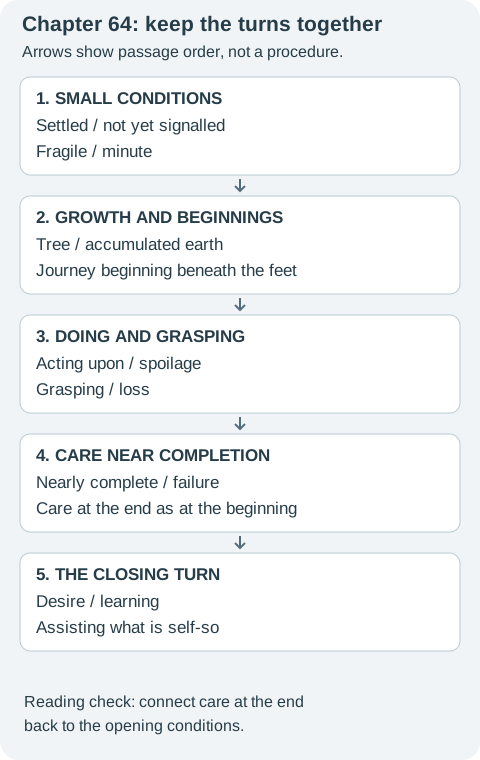
Try reading the journey line once on its own, then once after the warning about grasping and the care-at-the-end sentence. The change in your explanation is useful evidence of what the surrounding words contribute.
Record what an excerpt retains and what it leaves out
| Fragment | Immediate topic | What a whole-chapter claim still needs |
|---|---|---|
| 千里之行,始於足下 | journey / beginning | The tree, accumulated earth, warning about grasping, near-completion problem and final naturalness. |
| 慎終如始,則無敗事 | care / completion | The chapter’s questions about contrived action, desire and what the sage assists. |
| 無為故無敗 | nonaction / spoilage | The earlier instruction to attend before disorder and the concluding word 輔, assisting. |
| 以輔萬物之自然 | assistance / self-so | The earlier account of small conditions and a warning against grasping. |
You can quote a fragment without pretending it contains everything. Name the work, chapter, edition and translator. If you add a sentence about a contemporary situation, label it as your explanation or analogy.
TEXT / CHAPTER / EDITION OR DISPLAYED SOURCE:
EXACT CHINESE FRAGMENT:
TRANSLATOR / MY OWN WORKING TRANSLATION:
CLAUSE BEFORE / CLAUSE AFTER:
WHAT THE WHOLE CHAPTER ADDS:
COMMENTARY: WHOSE WORDS / WHERE:
MY APPLICATION, CLEARLY LABELLED:
WORDING OR INTERPRETATION TO CHECK:
Open the editable chapter and quotation record for the complete Chinese, our nine translation units, word checks and all eight explained cases.
For a different passage structure, the chapter 48 reading follows learning, reduction and governing. The chapter 40 guide examines returning, weakness, being and nonbeing. Compare their actual clauses rather than merging all three into one slogan about effort.
Eight cases: text, commentary and your own application
Use the Chinese and the named sources above to try these cases. The explanations show which piece of evidence supports the answer.
Case 1
A card says “A journey of a thousand miles begins with a single step.” Is that the exact Chinese wording printed here?
Show answer and explanation for case 1
No. It is a familiar English rendering or paraphrase.
The selected Chinese says 千里 and 足下. Our closer working English retains “a thousand li” and “beneath the feet.” Credit a named translator for a quoted English version.
Case 2
You quote the journey line as a fragment. Must you print the entire chapter beside it every time?
Show answer and explanation for case 2
No. Identify the fragment and its source clearly.
A short quotation can be useful. If you claim to explain the whole chapter, its later warnings and ending become part of the evidence you need.
Case 3
Does the chapter describe failure only when an undertaking first starts?
Show answer and explanation for case 3
No. It explicitly mentions failure near completion.
民之從事,常於幾成而敗之 is followed by 慎終如始. Keeping care through the end is one of the chapter’s central turns.
Case 4
Wang Bi’s note says 此四者,皆說慎終也. Should it be inserted into the chapter as another Laozi sentence?
Show answer and explanation for case 4
No. Keep the commentary separate.
The note interprets the first four conditions through care at the end. It is useful evidence for a named reading, while remaining a commentator’s words.
Case 5
Someone calls 無為 a command to ignore every emerging problem. Which words complicate that reading?
Show answer and explanation for case 5
為之於未有,治之於未亂 and 輔.
The chapter speaks of attending before disorder and assisting. A reading of nonaction needs to explain these words alongside the warning about acting upon and grasping.
Case 6
Does 始於足下 literally state that success is guaranteed once a project begins?
Show answer and explanation for case 6
No. That promise is an addition.
The passage contains warnings about spoilage and loss. A motivational use may draw on the image, but it should be identified as an application rather than a guaranteed result.
Case 7
The checked webpage is titled Wang Bi edition. Does that prove every displayed character is identical to an autograph Wang Bi used?
Show answer and explanation for case 7
No. A received edition has its own transmission history.
The SEP discussion distinguishes received versions, early witnesses and later changes. This guide names its base text and does not reconstruct an original manuscript.
Case 8
You use the chapter to reflect on a draft that is almost finished. How can you show where the ancient text ends and your example begins?
Show answer and explanation for case 8
Quote 幾成 and 慎終, then label the draft example as your analogy.
The words support a question about care near completion. Your imagined editing situation is not an ancient case study or proof of a universal project method.
Sources and further reading
- Dao De Jing, received text displayed with Wang Bi commentaryComplete displayed chapter 64 and its separate notes; our working English and original reading divisions.
- Stanford Encyclopedia of Philosophy: Laozi — textual traditionsNamed received versions, early witnesses and chapter arrangements; not a reconstruction of unread manuscript images.