Practical guide
Dao De Jing Chapter 40: Returning as the Movement of Dao
Parse the four clauses before turning returning or weakness into a slogan. Compare translation choices, named Wang Bi notes and two readings of being and nonbeing, with a clause map and six checks.
Read the complete chapter and keep the edition visible
Chapter 40 of the Dao De Jing, also called the Tao Te Ching, connects returning, weakness, being and nonbeing in an unusually compact passage. Its shortness invites quotation, but a single attractive line does not explain how the clauses belong together.
The Chinese below follows the linked received edition presented with Wang Bi’s commentary. We separate its four clauses from the surrounding notes. All English renderings here are our own working translations, with choices explained; they are not quotations attributed to a modern published translator.
反者道之動,
弱者道之用。
天下萬物生於有,
有生於無。The final received sentence can be divided into two clauses for analysis without inventing another chapter line. Modern punctuation is part of the presentation, and the display here does not claim that all historical witnesses have the same punctuation, wording or chapter divisions.
Our first rendering is “Returning is the movement of Dao; weakness is the functioning of Dao. The myriad things under heaven arise from being; being arises from nonbeing.” Read it once as a whole, then identify where each English term can narrow what you hear.
Parse the parallel clauses before expanding their meaning
| Received Chinese | Our working translation | Sentence relation |
|---|---|---|
| 反者道之動, | Returning is the movement of Dao; | Returning / movement of Dao |
| 弱者道之用。 | weakness is the functioning of Dao. | Weakness / functioning of Dao |
| 天下萬物生於有, | The myriad things under heaven arise from being; | Myriad things / arise from being |
| 有生於無。 | being arises from nonbeing. | Being / arises from nonbeing |
The opening two clauses have the parallel form X 者 道之 Y. In this reading, zhe (者) helps mark the expression being discussed, while zhi (之) links Dao to its movement or functioning. English needs a supplied “is” to make that relation sound natural. The addition is a translation aid, not another visible Chinese character.
The second pair repeats sheng yu (生於), rendered here as “arise from.” The subject changes from wan wu (萬物), the myriad things, to you (有), being. That change matters: the last clause asks the reader to consider the source of what the preceding clause already called a source.
Tian xia (天下) is kept as “under heaven,” and “myriad things” keeps the conventional breadth of 萬物. Neither phrase gives an exact inventory of ten thousand objects. The clause concerns the many things in the world, not a numerical counting task.
Compare returning and reversing without promising a reversal of fortune
Fan (反, fǎn) can make a translator emphasize a return, a reversal or movement back towards a source. Our title selects “returning” because the chapter can be read with the work’s repeated concern for dependence on what is prior or less apparent. “Reversing” makes the challenge to an ordinary direction or value more audible.
These are English emphases to compare, not two different Chinese sentences. A guide that chooses one should say what the choice illuminates and what it might conceal. “Returning” may sound like a peaceful homecoming; “reversing” may sound like an automatic switch of circumstances. Neither tone should replace explanation.
| Chinese term | Working choice here | A question to keep open |
|---|---|---|
| 反 fan | Returning | What direction or dependence is being reconsidered? |
| 弱 ruo | Weakness | How does apparent weakness relate to functioning? |
| 用 yong | Functioning | Does “use” suggest a tool or a way of operating? |
| 有 / 無 you / wu | Being / nonbeing | Does English make either into a particular substance? |
| 生於 sheng yu | Arise from | Is the relation read as temporal generation or priority? |
A modern reflection about revisiting the source of a problem may be useful. It remains your reflection. The clause does not state that every defeat becomes success, every financial loss is reimbursed, or every event must repeat in a measurable cycle.
Read weakness as a claim about functioning, then compare its neighbors
The second clause says 弱者道之用. Our “weakness is the functioning of Dao” keeps the pairing with the preceding movement clause. A rendering such as “weakness is the use of Dao” is closer to the familiar everyday word “use,” but may make Dao sound like an instrument someone can deploy.
There is no explicit “defeats the strong” in this clause. Those victory contrasts occur elsewhere, including the related chapter 78 water passage. The two can illuminate each other without allowing us to transplant a sentence from one into the other.
Wang Bi’s brief note here connects softness and weakness with openness or passage that cannot be exhausted. That reading emphasizes efficacy without treating rigid force as the only effective condition. It does not turn weakness into a rule that people should tolerate mistreatment or abandon necessary responsibilities.
Try this distinction when writing a caption: “Chapter 40 associates weakness with Dao’s functioning; I compare it with the yielding water of chapter 78.” That is more precise than labeling a mixed collection of clauses as one complete quotation from chapter 40.
Read both being and nonbeing clauses before choosing a metaphysical account
The chapter does not stop at “myriad things arise from being.” It immediately says that being arises from nonbeing. Omitting the last clause changes the problem: a first source is itself placed in relation to something not captured by the same description.
“Being” and “nonbeing” are useful working terms because they preserve the contrast of you and wu. They also sound abstract in English. “What is” and “what is not,” or “having” and “not having,” can reveal other resonances, but each needs an explanation of what is being claimed in this particular sentence.
The Stanford Encyclopedia of Philosophy’s Laozi entry, section 6, compares a cosmological interpretation with one emphasizing ontological priority. In the former, the question concerns the generation and sustaining source of the world. In the latter, “beginning” need not name a past event: it concerns the ground or priority required to understand being.
| Reading emphasis | Question it asks | Limit to state |
|---|---|---|
| Cosmological generation | How do differentiated things emerge and remain sustained? | The ancient passage is not an experimental description of a contemporary theory. |
| Ontological priority | What must be considered prior to particular beings? | Priority need not be a dated event or another powerful object. |
The encyclopedia discusses Heshang Gong and Wang Bi in explaining these approaches. Here we have directly checked the displayed Wang Bi chapter notes; we have not presented an independently read Heshang Gong passage. Keep that difference in source use visible.
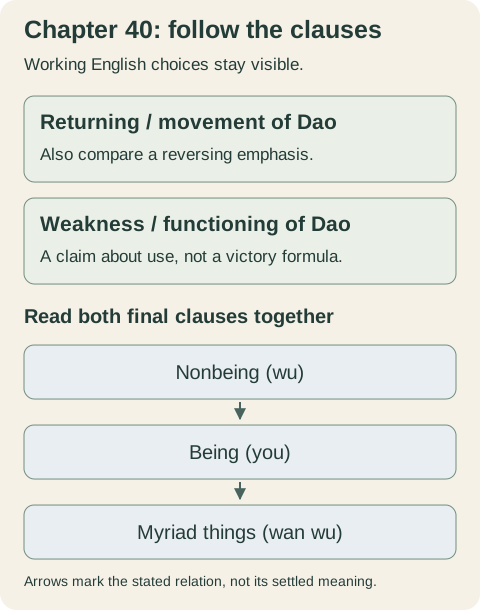
The reading map below places nonbeing before being before myriad things to display the relation stated by the clauses. Its arrows do not settle whether that relation describes temporal creation, conceptual dependence or another interpretation.
Use Wang Bi’s notes as named commentary, not extra verse
The linked edition places three notes around the chapter’s clauses. The first explains reversal through dependence: the high takes the low as its foundation, the honored takes the lowly as its root, and being takes nonbeing for its use. Those are Wang Bi’s examples of the relation.
高以下為基,貴以賤為本,有以無為用,此其反也。Wang Bi’s commentary; our translation: “The high takes the low as its foundation, the honored takes the lowly as its root, and being takes nonbeing for its use: this is its reversal.”
That note gives “returning” a concrete interpretive pressure. What looks elevated or self-sufficient depends on what may appear lower or absent. It is a reading of the chapter, not a guarantee that all social rankings will swap places.
將欲全有,必反於無也。From Wang Bi’s final note; our translation: “If one wishes to preserve being in its wholeness, one must return to nonbeing.” “Preserve in its wholeness” explains our rendering of quan (全); it is not an instruction added to the received clause 有生於無.
Keep the heading “commentary” on both excerpts. A reader can then assess the original words, our English and the commentator’s explanation as three related layers instead of assuming they are one undisputed speech by Laozi.
Compare named chapters without merging their wording
| Chapter | Chinese anchor checked here | What the comparison adds |
|---|---|---|
| 16 | 各復歸其根 | Returning to root belongs to a longer observation, constancy and action sequence. |
| 41 | 進道若退 | Apparent retreat challenges an ordinary judgment of progress. |
| 42 | 道生一,一生二,二生三,三生萬物 | Generation is described through a different unity-to-multiplicity sequence. |
| 78 | 弱之勝強,柔之勝剛;正言若反 | Water, victory contrasts and burdens of rule give weakness a distinct context. |
The existing chapter 16 guide follows the complete returning-to-root sequence. Its fu (復) is not silently replaced by chapter 40’s fan (反), even though the questions are related. Compare the actual characters before claiming two English words prove the chapters are identical.
Chapter 41 makes apparent retreat part of a series of difficult value judgments. Chapter 42 gives another account of generation; its numbers should not be casually assigned to a modern theory. Chapter 78 includes the burdens of rule as well as water, so its ending deserves attention too.
The chapter 36 resource remains a separate task: four intended reversals followed by fish and the state’s effective instruments. A shared interest in reversal is a reason for an internal reading link, not a reason to republish that guide under a new title.
Use a reading record and six checks before quoting chapter 40
Fill in the record with one clause and one explained English choice. If a comparison, commentator’s note or modern analogy is doing the interpretive work, name it. Writing an unresolved question is more useful than adding a confident promise the Chinese does not state.
CHAPTER 40 - TEXT, TRANSLATION AND INTERPRETATION
Edition and chapter:
Chinese clause being quoted:
Our / named translator's exact English:
English words supplied to make the sentence readable:
Fan: returning, reversing or another explained choice:
Ruo and yong: what relation does the clause actually state:
You / wu / sheng: wording and interpretive uncertainty:
Named commentator and separate quoted note:
Comparison chapter and its actual Chinese words:
My analogy; claim it does not establish:
Download the received text, our translations, reading record and answer notes (TXT).
The cases below test sentence relations and attribution. They do not certify philosophical expertise or show that a modern personal strategy will succeed.
Case 1
Which Chinese pattern links the first two clauses, and where does an English “is” come from?
Show answer and explanation for case 1
Both use X 者 道之 Y. “Is” is supplied in our English to express the relationship.
者 marks the topic-like expression; 之 joins Dao with movement or functioning. The Chinese does not contain a separate word identical to the supplied English copula.
Case 2
A card says, “Returning means every loss will become a win.” Is that a translation of 反者道之動?
Show answer and explanation for case 2
No. The win/loss guarantee has been added.
Returning and reversing are interpretive English emphases. Neither makes the brief clause into a prediction that every personal setback must produce a reward.
Case 3
Where does chapter 40 say that the weak always defeat the strong?
Show answer and explanation for case 3
It does not use that wording. Its second clause relates weakness to Dao’s functioning.
Chapter 78 contains weak/strong and soft/hard victory pairs. Comparing the chapters is useful; moving their clauses into each other changes the received text.
Case 4
A reader quotes only “myriad things arise from being.” What does the next clause add?
Show answer and explanation for case 4
Being itself arises from nonbeing.
The second relation prevents the first from being read as a self-contained claim that being needs no explanation. Both clauses belong to chapter 40, even when a caption quotes only a fragment.
Case 5
May 王弼’s sentence 高以下為基 be printed among the four received clauses and labeled Laozi’s original verse?
Show answer and explanation for case 5
No. It belongs to Wang Bi’s commentary in this edition.
Label the commentary separately. It supports an interpretation through high/low and honored/lowly dependence; it is not an additional received clause.
Case 6
A modern science headline claims chapter 40 proves a particular cosmological model. What should a reading guide require?
Show answer and explanation for case 6
Separate the historical text and its interpretive readings from the modern scientific claim.
The chapter does not specify a measured mechanism, date, experiment or contemporary theory. A conceptual comparison is an analogy; it cannot serve as empirical proof.
Sources and further reading
- Dao De Jing received text with Wang Bi commentaryComplete chapters 1, 16, 40, 41, 42 and 78 checked for the selected comparisons; all English renderings and the clause map here are original.
- Stanford Encyclopedia of Philosophy: Laozi, section 6, Dao and VirtueComplete section 6 checked for Dao, being/nonbeing, cosmological and ontological interpretations. Mentioned Heshang Gong passages were not independently read.