Practical guide
Dao De Jing Chapter 36: Softness and Strength in Context
Follow the four reversals through softness and strength to the fish-and-state ending. Separate the received Chinese, our working translation, Wang Bi commentary and your own modern analogy.
Read the complete received chapter before choosing a slogan
Chapter 36 of the Dao De Jing, also known as the Tao Te Ching, places “the soft and weak overcome the hard and strong” after four reversals, then follows it with fish in a deep pool and the state's effective instruments. Read that sequence before reducing the chapter to a rule about gentleness, secrecy or getting what you want.
The Chinese below follows the received chapter in the linked edition presented with Wang Bi's commentary. It is not a claim that every manuscript has identical wording or chapter divisions. The English throughout this guide is our own working translation. Wang Bi's notes are identified separately; they are not extra sentences spoken by Laozi.
將欲歙之,必固張之;
將欲弱之,必固強之;
將欲廢之,必固興之;
將欲奪之,必固與之。
是謂微明。
柔弱勝剛強。
魚不可脫於淵,
國之利器不可以示人。
The work is traditionally associated with Laozi, and its textual and interpretive history is complex. For this reading task, the important first distinction is between the chapter's words, a commentator's explanation and your own application. Keeping the three layers visible makes disagreement easier to understand.
Our translation keeps the eight clauses and their pressure points
| Received Chinese | Our working translation | What to keep in view |
|---|---|---|
| 將欲歙之,必固張之; | If you intend to draw it together, you must first let it spread out. | The intended drawing-in is preceded by spreading out. |
| 將欲弱之,必固強之; | If you intend to weaken it, you must first let it grow strong. | The intended weakening is preceded by strengthening. |
| 將欲廢之,必固興之; | If you intend to remove it, you must first let it rise. | The intended removal is preceded by raising up. |
| 將欲奪之,必固與之。 | If you intend to take it away, you must first give it. | The intended taking is preceded by giving. |
| 是謂微明。 | This is called subtle illumination. | Names the preceding pattern; it is not a new instruction. |
| 柔弱勝剛強。 | The soft and weak overcome the hard and strong. | Pairs softness/weakness with hardness/strength. |
| 魚不可脫於淵, | Fish must not leave the deep pool; | Introduces a creature and the depth that sustains it. |
| 國之利器不可以示人。 | the state's effective instruments must not be displayed to people. | Ends with the state, instruments and showing them. |
In the first four lines, jiang yu (將欲) introduces an intention or an impending wish, and the repeated zhi (之) is rendered as “it.” The lines do not identify a modern company, adversary or relationship. Substituting one of those into every “it” is an application you have supplied.
“First” makes the proposed order clear in our English rendering of bi gu (必固); it is a translation choice, not an additional Chinese word visible by itself in the line. “Let” also favors a reading of allowing a development rather than prescribing a precise intervention. A more forceful rendering such as “make it strong” would sound more directly strategic. Compare those effects before treating the English as neutral.
Xi (歙) carries the drawing-in side of the first contrast; zhang (張) the spreading-out side. Rou ruo (柔弱, róu ruò) is paired with gang qiang (剛強, gāng qiáng). We keep both pairs rather than flattening them into only “soft wins.” Wei ming (微明, wēi míng) is rendered here as “subtle illumination,” but its connection with the preceding pattern remains an interpretive question.
The four reversals lead into two final images
The repeated form is an efficient way to read the opening: an intended outcome is paired with an apparently opposite prior condition. Rather than choosing the most attractive one of the four pairs, ask what makes the repetition significant. Is it a sequence to arrange, a pattern to notice or a paradox about the limits of direct force?
The text then names the pattern and states the soft/weak and hard/strong contrast. It still has not finished. The fish and state-instrument lines move the reader into images of dependence, effectiveness and display. Leaving them out makes a simpler quotation, but also makes the chapter appear less concerned with governance.
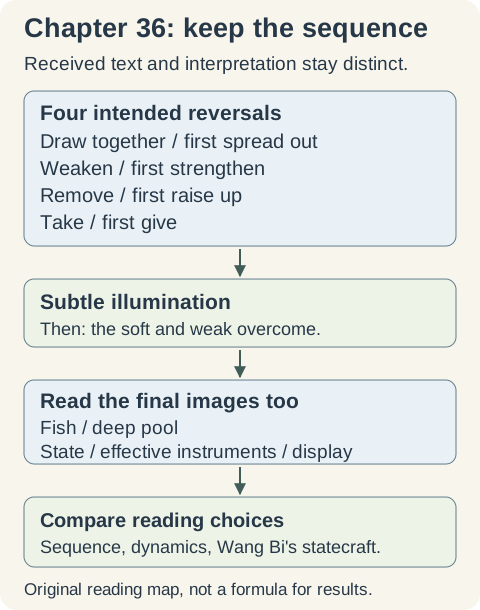
Try a small annotation exercise: mark each “intend” line, underline the contrasting action and put a box around the final two images. You can then see which parts an English explanation has used and which parts it has quietly left behind.
Fish, the deep pool and Wang Bi’s explanation of the state’s instruments
The fish line presents a creature in relation to the place that sustains it. A fish separated from the deep pool loses that supporting condition. The next line brings in the state and its li qi (利器). A translation may emphasize sharp or powerful instruments and suggest weapons; our working “effective instruments” leaves room for a broader political reading.
The relationship between the two images needs explanation. “Keep your talents secret” is one possible modern analogy someone might make, but the Chinese mentions the state, not a private career. Equally, the ending should not be deleted because it complicates an uplifting quote about softness.
In the Wang Bi commentary beside this chapter, the note on the opening speaks about removing violent or overbearing forces by working with their nature. Its discussion of “effective instruments” turns toward how things are governed, rather than simply identifying a hidden stock of weapons.
因物之性,不假刑以理物From Wang Bi's note; our translation: “Follow the nature of things, without relying on punishment to order them.” This is commentary on the chapter's political effectiveness. It should not be inserted into the received Chinese as another line of the chapter.
示人者,任刑也。From Wang Bi's note; our translation: “Showing them to people means relying on punishment.” In this reading, display is connected with visible coercive rule. That differs from a straightforward instruction to conceal military hardware. The note helps explain why the fish image belongs with the state's instruments, but it does not remove all interpretive difficulty from the passage.
Compare three readings without pretending the disagreement has disappeared
The conditional phrasing can sound strategic: to achieve one result, arrange the opposite beforehand. The repeated contrasts can also be read as a warning about changing conditions and the instability of rigid force. Wang Bi's comments locate the passage in governing and handling overbearing power. These emphases overlap, but they are not interchangeable.
| Reading emphasis | Words or context it uses | What it highlights | Question left open |
|---|---|---|---|
| A deliberately arranged sequence | The four “intend” clauses and opposite prior actions. | The indirect route toward an intended result. | How far does the passage permit a reader to supply an actor, target and tactic? |
| Reversal and changing conditions | Expansion/contraction and strong/weak contrasts. | The limits of treating present strength as stable effectiveness. | When is the language describing a development, and when is it advising an action? |
| Political restraint in Wang Bi's commentary | The notes on violence, nature, punishment and the state's instruments. | Effectiveness that does not depend on openly coercive rule. | How should the commentary guide, rather than replace, the received chapter? |
The Stanford Encyclopedia of Philosophy's Laozi entry, in its section on naturalness and nonaction, discusses why different interpretive frameworks matter. It distinguishes nonaction from total inactivity and explains how paradoxical language challenges ordinary value judgments. That broader discussion gives a useful setting for this comparison; it is not a separate sentence-by-sentence translation of chapter 36.
A good explanation names its reading choice. If it calls the opening a tactic, it should explain the ending too. If it describes spontaneous reversal, it should still face the language of intention. If it follows Wang Bi, it should show which statements are his notes and which are the chapter's words. Saying “Laozi simply means” skips the work that makes the reading useful.
For a modern reflection, you might ask whether applying more direct force is making a process more resistant. That is your analogy. It is not evidence that a particular strategy always succeeds, that giving guarantees a later gain or that vulnerable people should accept mistreatment.
Chapter 36 and chapter 78 use related words in different sequences
The familiar water passage belongs to chapter 78, not chapter 36. In the same linked received edition, chapter 78 opens with water as soft and weak, then develops the weak/strong and soft/hard pairs. Its ending turns toward bearing the state's disgrace or misfortune and toward statements that seem reversed.
| Check | Chapter 36 | Chapter 78 |
|---|---|---|
| Opening image or form | Four intended reversals. | Water confronting the hard and strong. |
| Wording of the contrast | 柔弱勝剛強。 | 弱之勝強,柔之勝剛。 |
| Ending to keep | Fish, the deep pool and the state's effective instruments. | Burdens of rule and 正言若反, words that seem reversed. |
| A common shortening | A slogan about softness, or giving before taking. | A slogan about water, leaving the burdens of rule out. |
The existing chapter 78 water quotation guide provides a separate route for its quoted passage. Keep the chapter number with each Chinese line. Shared vocabulary is a reason to compare the chapters, not to merge their original wording.
Chapter 37 is another useful neighbor: it begins with the Way and nonaction and continues with rulers and transformation. The wu wei guide examines that line alongside chapter 48. Reading these neighboring political and ethical questions helps prevent chapter 36 from becoming an isolated maxim.
Three fictional quotation edits show what context changes
These invented editorial examples demonstrate checking, not the success of an ancient strategy in modern life.
1. A quote card promises a later reward
A card paraphrases the giving/taking line as “Give generously and the universe will give you more,” then signs it “Laozi.” The new claim of a guaranteed return is not in the received clause.
Better caption: “Chapter 36 pairs intended taking with prior giving. This is my reflection on that line, not a quotation promising that every gift is rewarded.”
The edit preserves an opportunity to reflect while removing the invented quotation and guarantee.
2. Commentary is silently promoted into the chapter
A reading sheet puts Wang Bi's explanation about punishment into the Chinese verse and calls the complete paragraph “Laozi's original words.” That hides the distinction between the received text and a named interpretation.
Better label: “Received chapter 36” for the eight clauses, followed by “Wang Bi's note; our translation” for the discussion of governing without punishment.
The reader can now compare the two layers instead of being asked to treat the commentary as an undisputed extra verse.
3. Water is assigned to the wrong chapter
A learner quotes the water passage under “Chapter 36: softness and strength.” The words are relevant to the theme, but the chapter number is wrong.
Better comparison: “Chapter 36 states 柔弱勝剛強 within its reversal and state-instrument sequence. Chapter 78 starts with 天下莫柔弱於水 and develops another argument.”
The correction creates a clearer cross-reference and keeps each chapter's ending available for further reading.
Use a reading record and six checks before quoting the chapter
Use the blank record to separate quotation, translation and interpretation. If you are unsure what the repeated “it” names, write that uncertainty down rather than inserting a modern target without explanation.
CHAPTER 36 — QUOTATION AND CONTEXT RECORD
Edition and chapter:
Chinese line I am quoting:
The clauses immediately before and after it:
My working translation; supplied English words:
What the repeated “it” refers to, or leaves unspecified:
Fish, deep pool and state-instrument ending included:
Text, Wang Bi note or my own analogy — label the layer:
One reading that fits; one limit it does not settle:
CHAPTER 36 AND CHAPTER 78 — KEEP THE REFERENCES SEPARATE
Chapter 36: four reversals, subtle illumination, fish and state.
Chapter 78: water, weak/strong pairs and burdens of rule.
Exact Chinese wording and source location:
What a shortened English slogan drops:
What the full ending changes in my interpretation:
Commentator and the words actually supporting that reading:
Modern example is an analogy, not a promise from Laozi:
Download the received Chinese, our translation, both blank records and six answer notes. Try the cases before opening the explanations; they check attribution and context, not whether someone has mastered a life strategy.
Case 1
Someone quotes “the soft and weak overcome the hard and strong” from chapter 36. Which parts should a full contextual explanation also read?
Show answer and explanation for case 1
The four reversals before it, and the fish and state-instrument lines after it.
The received chapter gives the contrast a sequence and an ending. A shortened quotation can be labeled as a fragment, but it should not silently stand in for the whole chapter.
Case 2
Our English first line includes “first let it spread out.” Are “first” and “let” independent extra Chinese words that every translator must use?
Show answer and explanation for case 2
No. They are choices in this working rendering of the clause.
The English clarifies an order and favors an allowing reading. A translator who supplies a more forceful action can change the emphasis; identify that choice instead of treating the English as the untouched original.
Case 3
Wang Bi explains showing the instruments in terms of relying on punishment. May that note be inserted into the chapter as another sentence by Laozi?
Show answer and explanation for case 3
No. Label it as Wang Bi's commentary and separate its translation.
The note supports a particular political reading. It is valuable because it shows an interpretation, not because the commentator's words are interchangeable with the received chapter.
Case 4
A modern card says that giving will always bring a larger reward and attributes the promise to Laozi. Does the giving/taking clause establish that guarantee?
Show answer and explanation for case 4
No. The guaranteed reward is an added modern claim.
The chapter pairs intended taking with prior giving, without stating that every act of generosity produces a gain. Label a modern reflection as your own and do not manufacture a sourced quotation.
Case 5
Which chapter begins with the familiar line “天下莫柔弱於水,” chapter 36 or chapter 78?
Show answer and explanation for case 5
Chapter 78. Chapter 36 opens with four reversals.
Related soft/weak and hard/strong words do not erase their different sequences. Cite the correct chapter and retain its ending when explaining the passage.
Case 6
Does the fish-and-state ending settle every question as a simple instruction to hide your personal talents?
Show answer and explanation for case 6
No. That is a modern analogy, not a complete reading of the political wording.
The received text names the state's instruments, and Wang Bi interprets their display through coercive rule. Explain your chosen connection rather than turning a career slogan into the only meaning.
Sources and further reading
- Dao De Jing, received text with Wang Bi commentaryComplete chapter 36 and its notes; chapters 35, 37 and 78 for the selected comparisons. English translations and the reading diagram here are original.
- Stanford Encyclopedia of Philosophy: Laozi, section 7, Naturalness and NonactionInterpretive frameworks, nonaction and paradox in the broader work. This contextual section is not a separate line-by-line translation of chapter 36.