Practical guide
Dao De Jing Chapter 39: The One and the Foundation of Rank
Chapter 39 pairs six effects of obtaining the One with risks of losing their basis. Read the low foundation of rank, compare the difficult carriage and jade/stone endings, and keep unresolved glosses visible.
Read the six effects and their paired failure conditions
This guide follows chapter 39 in the displayed received Chinese edition with commentary attributed to Wang Bi. The complete chapter words below exclude the displayed notes. Punctuation helps reading; it does not establish an original autograph.
昔之得一者,天得一以清,地得一以寧,神得一以靈,谷得一以盈,萬物得一以生,侯王得一以為天下貞。其致之,天無以清將恐裂,地無以寧將恐發,神無以靈將恐歇,谷無以盈將恐竭,萬物無以生將恐滅,侯王無以貴高將恐蹶。故貴以賤為本,高以下為基。是以侯王自稱孤﹑寡﹑不穀。此非以賤為本邪?非乎?故致數輿無輿,不欲琭琭如玉,珞珞如石。Those of old that obtained the One: heaven through it became clear; earth settled; spirits effective; valleys full; the myriad things alive; lords and kings a standard under heaven. These are what it brings about. Without the means for clarity heaven would risk splitting; without settledness earth would risk breaking open; without efficacy spirits would risk ceasing; without fullness valleys would risk drying up; without life things would risk perishing; without the basis of honor and height rulers would risk falling. Thus honor takes the lowly as its root, and height takes the low as its foundation. Lords and kings therefore call themselves gu, gua and bu gu. Is that not taking the lowly as the root? Is it not? So, to arrive at counting a carriage is to have no carriage. Do not desire to be glittering like jade or knobbly like stone.
The Stanford account of textual traditions explains why an edition belongs beside the conventional chapter number. Its discussion also cautions that received texts accompanying Wang Bi have undergone later changes. This guide reads one identified display and compares James Legge’s printed English; it does not collate every manuscript.
The One is linked to six distinct conditions
The opening 得一 is repeated across six subjects, not only heaven and earth. Wang Bi’s displayed note calls 一 the beginning of number and relates it to the basis by which each thing forms. That is a philosophical commentarial account. This guide does not identify the One with a measured physical quantity or a modern scientific force.
On a narrow screen, swipe this table sideways, or focus it and use the right-arrow key.
| Subject | Effect after 得一 | Failure named afterward |
|---|---|---|
| 天, heaven | 清, clarity | 裂, splitting |
| 地, earth | 寧, settledness | 發, breaking open |
| 神, spirits | 靈, efficacy | 歇, ceasing |
| 谷, valleys | 盈, fullness | 竭, drying up |
| 萬物, things | 生, life | 滅, perishing |
| 侯王, rulers | 貞, a standard | 蹶, falling |
The political failure clause uses 貴高, honor and height, rather than mechanically repeating 貞 from the opening. Keep that change visible. A table that quietly makes every second phrase identical to the first may be easier to scan but less faithful to the source.
Wang Bi distinguishes a result from what sustains it
Under the heaven clause, Wang Bi says in effect that the One brings clarity, while clarity does not make itself clear. His concern is what happens when a completed result is treated as its own sufficient basis. He extends that reading to fullness and the other effects, and describes losing the mother or root.
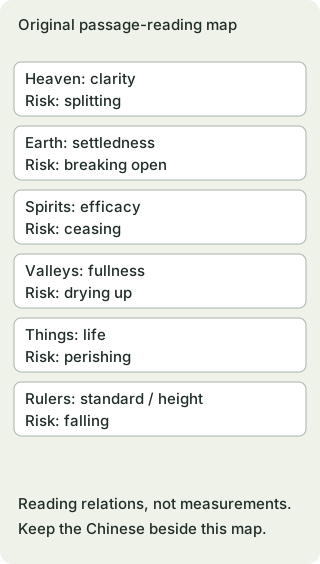
That distinction gives a way to read the repeated risks. The chapter is not simply listing six things that are pleasant to have. It asks the reader to retain the basis that makes their condition possible. Our map shows the textual pairs; it cannot demonstrate that clouds, valleys or governments operate through one empirically established mechanism.
The broader root vocabulary resembles chapter 26’s heavy/light relation, but chapter 26 discusses travel, baggage and agitation. Shared language can support a comparison without transferring its chariots or its entire argument into chapter 39.
Rank depends on a low foundation, not a flattering description
故貴以賤為本,高以下為基 states the foundation relation directly. Honor takes the lowly as root, and height takes the low as foundation. The chapter then names three ruler self-descriptions, 孤、寡、不穀, before asking whether they acknowledge that relation.
Our English retains gu, gua and bu gu rather than presenting a definitive etymology of all three. Their placement makes the point of lowered self-description inspectable. A detailed historical dictionary treatment would be another research task; it should not be invented to make every word look settled.
Legge’s printed English gives “Orphans,” “Men of small virtue” and “Carriages without a nave.” Those are his identified glosses, not three translations this page independently verifies from a dictionary. A reader can record the difference and request the relevant apparatus before deciding why that rendering uses the vehicle expression.
Nor does a ruler’s using humble titles prove ethical conduct. The verse presents a philosophical relation and a practice of naming; a modern conclusion about a particular person would require evidence of that person’s actions.
Keep the carriage and jade/stone lines open to inspection
故致數輿無輿 is difficult. Our deliberately provisional “to arrive at counting a carriage is to have no carriage” keeps the carriage terms visible. Legge explains it as enumerating parts without reaching what makes a carriage fulfill its purpose. Wang Bi’s nearby discussion emphasizes a mother or basis that is not exhausted by the completed form. Those are explanatory routes, not a complete collation of the sentence’s history.
The final 不欲 governs jade and stone images in this display. Wang Bi’s note treats both as exhausted in form and says they are therefore not desired. That supports reading a refusal to be confined to either conspicuous appearance. Our “glittering” and “knobbly” are working descriptive choices for the paired terms, not an analysis of actual mineral specimens.
Legge instead writes that they prefer to be coarse-looking as ordinary stone rather than elegant-looking as jade. The identified English comparison therefore matters: his version makes a preference explicit, while our reading follows the displayed commentary’s refusal of both forms. Establishing Legge’s textual basis needs further evidence; the difference alone does not prove he fabricated a line.
Build a note that states both its result and its limits
A useful note can say: “I read the six 得一 effects with their subsequent risk clauses; Wang Bi’s note helps distinguish a result from its sustaining basis. The rank and self-description clauses then apply a low-foundation relation to rule. I leave the carriage wording provisional.” That is stronger than “everything is one,” because each inference has a visible place in the text.
If you compare it with chapter 66’s rivers and seas, specify the difference. Chapter 66 moves from being below valleys to speech and bodily placement in leadership. Chapter 39 begins with six obtaining-the-One conditions and only later reaches rank. Their spatial vocabulary does not erase those distinct sequences.
Quote the exact clause you need, identify the conventional chapter and edition, and name the translator. Unresolved wording belongs in the note rather than disappearing from it. That gives a later reader something concrete to verify or improve.
Try three complete reading checks
These are original editorial exercises. Decide which words or source layer support the claim before opening each explanation.
Case 1
A summary lists only heaven and earth as the chapter’s obtaining-the-One examples. What complete list should it restore?
Show answer and explanation for case 1
Heaven, earth, spirits, valleys, the myriad things, and lords or kings.
All six are explicit in the received opening. The later risk clauses should be compared with that full list rather than inferred from only two examples.
Case 2
A quotation says Wang Bi’s displayed note conclusively commands choosing rough stone over jade. Does the note as read support that precise claim?
Show answer and explanation for case 2
No. The selected note says jade and stone are exhausted in form and therefore not desired.
Legge’s English makes a preference for stone explicit. Keep the named English rendering and the displayed commentary separate instead of treating them as identical evidence.
Case 3
A reader calls the One an experimentally verified force that quantitatively explains all six effects. What evidence is missing?
Show answer and explanation for case 3
Experimental definitions, measurements and a tested model; none are supplied by this passage-reading guide.
The chapter and commentary offer a philosophical relation. An original diagram is a map of words and risks, not empirical proof about the physical or political world.
Sources and further reading
- Dao De Jing: received chapter 39 and displayed Wang Bi commentaryComplete selected chapter and displayed commentary were read. Our English, clause maps and cases are original; the commentary remains a separate layer.
- James Legge, The Tao Teh King: chapter 39Complete identified English chapter was read. Quoted English is attributed to Legge; his underlying Chinese witness has not been established by this guide.
- Stanford Encyclopedia of Philosophy: Laozi, section 3, Textual TraditionsComplete section 3 was read for received and manuscript traditions. Linked manuscripts and the rest of the entry were not examined for this guide.