Practical guide
Dao De Jing Chapter 38: Virtue, Benevolence and Ritual in Sequence
Chapter 38 moves from higher and lower de through benevolence, righteousness and ritual. Trace action, aims, a demanded response and the loss sequence before reading the closing thick/thin choice.
Read the whole sequence before selecting a virtue quotation
This guide follows chapter 38 in the displayed received Chinese edition with commentary attributed to Wang Bi. The complete chapter words below exclude the displayed notes. Punctuation helps reading; it does not establish an original autograph.
上德不德,是以有德;下德不失德,是以無德。上德無為而無以為,下德為之而有以為。上仁為之而無以為,上義為之而有以為。上禮為之而莫之應,則攘臂而扔之。故失道而後德,失德而後仁,失仁而後義,失義而後禮。夫禮者,忠信之薄,而亂之首。前識者,道之華,而愚之始。是以大丈夫處其厚,不居其薄;處其實,不居其華。故去彼取此。Highest de does not de; therefore it has de. Lower de does not lose de; therefore it has no de. Highest de does not act and has no aim for acting; lower de acts and has an aim for acting. Highest benevolence acts and has no aim for acting; highest righteousness acts and has an aim for acting. Highest ritual acts, and when no one responds, it rolls up its arms and pulls them. Thus, after Dao is lost comes de; after de is lost comes benevolence; after benevolence is lost comes righteousness; after righteousness is lost comes ritual. Ritual is the thinning of loyalty and trust, and the beginning of disorder. Anticipatory knowing is Dao’s flower and the beginning of foolishness. Therefore the great person dwells in the thick, not the thin; in the solid, not the flower. So that is put away and this taken.
The Stanford account of textual traditions explains why an edition belongs beside the conventional chapter number. Its discussion also cautions that received texts accompanying Wang Bi have undergone later changes. This guide reads one identified display and compares James Legge’s printed English; it does not collate every manuscript.
The repeated de is part of the problem, not a missing label
The first clause repeats 德, conventionally romanized de, as something that highest de does not do or claim. Our deliberately awkward “does not de” retains that repetition before interpreting it. It is not polished English offered as a final dictionary solution.
Possible explanations include not asserting one’s de or not holding it as a self-conscious possession. Wang Bi’s displayed commentary develops a reading in which the highest de does not cling to its own de and uses Dao. His account supplies reasons for an interpretation; it is not permission to insert the English word “fake” into every occurrence of lower virtue.
The contrast 下德不失德 says lower de does not lose or let go of de, yet has no de. The apparent tension needs explanation. Reading it as “bad people never behave well” removes both the repeated word and the chapter’s concern with deliberate attachment. Keep the Chinese, your chosen English and the explanatory argument on separate lines.
Five descriptions distinguish action, purpose and response
The next sentences do not say every admired quality is motionless. Highest benevolence explicitly 為之, acts, while 無以為 withholds what our translation calls an aim for acting. Highest de instead has 無為 as well as 無以為. These are distinct descriptions, even when an English paraphrase makes them sound alike.
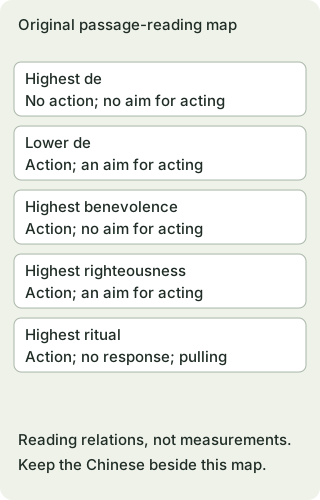
On a narrow screen, swipe this table sideways, or focus it and use the right-arrow key.
| Condition | Acting phrase | Further qualification |
|---|---|---|
| 上德 | 無為 | 無以為 |
| 下德 | 為之 | 有以為 |
| 上仁 | 為之 | 無以為 |
| 上義 | 為之 | 有以為 |
| 上禮 | 為之 | 莫之應; 攘臂而扔之 |
“Aim” explains our reading of 以為; it is not a separate noun written after that phrase. Compare Legge’s “with a purpose,” and notice how much English must supply to make the contrast readable. A useful reading acknowledges the addition rather than treating the supplied object as unambiguous source wording.
Why does the ritual sentence end with pulling?
The ritual description introduces a response problem: 莫之應, no one responds. The arms gesture then changes the mode of action. Our “rolls up its arms and pulls them” makes the pressure visible; the precise gesture is difficult, and Legge renders it as baring the arm and marching up to people. Both preserve a move beyond simply acting and awaiting response.
The repeated 失…而後… then describes Dao, de, benevolence, righteousness and ritual through a sequence of loss. It is not written as a curriculum in which advancing students earn increasingly prestigious virtues. Its relation is that a later term appears after the preceding basis is lost.
The next criticism of ritual follows that sequence: loyalty and trust have become thin, and disorder begins. This does not establish that every ritual performed in any society is fraudulent. The claim belongs to the chapter’s argumentative portrayal; a comparison with another text should retain the particular wording and acknowledge the philosophical disagreement.
The ending chooses substance over a flowering appearance
前識 is translated here as anticipatory knowing. Wang Bi explains it through knowing ahead of others and criticizes straining cleverness to manage affairs. Legge’s “swift apprehension” gives an identified alternative. Neither makes the sentence a blanket rejection of every useful anticipation.
The ending contrasts 厚 with 薄 and 實 with 華: thick versus thin, solid or substantial versus flower. The great person takes one side of those contrasts. It matters that the final choice follows the chapter’s account of actions, aims, responses and loss; it is more specific than a general instruction to keep a modest public image.
The older virtue-without-display comparison pairs the opening with Analects 4.24. That page has a different task. To cite chapter 38’s ritual pressure or whole loss sequence, use this complete chapter reading rather than make the opening two sentences stand for every later claim.
Compare one real English decision at a time
Legge describes de as “the attributes (of the Tao)” and adds explanatory parentheses around the people possessing them. Our version keeps de to leave its repeated use visible. The comparison therefore asks what a chosen English term clarifies and what it hides; it does not start by assuming one smooth noun settles the concept.
A good note might say: “The received descriptions distinguish acting from acting with an aim. I read the ritual ending as pressure for a response, informed by the arms gesture and Wang Bi’s explanation.” That identifies the clauses and the interpretive support. Calling the five descriptions a validated psychological scale would add an entirely different claim.
Before sharing an excerpt, decide whether you are quoting the opening paradox, the five conditions, the loss sequence or the closing choice. Give the conventional chapter number and identified translation, and call an excerpt a fragment. This makes disagreement about the interpretation possible without hiding what was actually read.
Try three complete reading checks
These are original editorial exercises. Decide which words or source layer support the claim before opening each explanation.
Case 1
A table labels both highest de and highest benevolence “no action.” Which written distinction should it restore?
Show answer and explanation for case 1
Highest de has 無為; highest benevolence has 為之, while both have 無以為.
Acting and having an aim for acting are different questions in the source. Combining them hides the exact distinction this section is trying to explain.
Case 2
A lesson calls Dao→de→benevolence→righteousness→ritual an ascending training ladder. Which repeated words challenge that label?
Show answer and explanation for case 2
失…而後… presents the later term after the preceding one is lost.
The chapter frames a sequence of loss. A modern training scheme would be an additional analogy and should not be presented as the printed sequence’s literal meaning.
Case 3
A reader quotes Wang Bi’s explanation of anticipatory knowing as if it were extra words inside the chapter. How should the evidence be labeled?
Show answer and explanation for case 3
Identify it as displayed commentary attributed to Wang Bi, separate from 前識者,道之華,而愚之始.
The note helps explain a difficult phrase. Its interpretive role should remain visible so another reader can compare the verse, commentary and English choice.
Sources and further reading
- Dao De Jing: received chapter 38 and displayed Wang Bi commentaryComplete selected chapter and displayed commentary were read. Our English, clause maps and cases are original; the commentary remains a separate layer.
- James Legge, The Tao Teh King: chapter 38Complete identified English chapter was read. Quoted English is attributed to Legge; his underlying Chinese witness has not been established by this guide.
- Stanford Encyclopedia of Philosophy: Laozi, section 3, Textual TraditionsComplete section 3 was read for received and manuscript traditions. Linked manuscripts and the rest of the entry were not examined for this guide.